Our Code of Conduct sets out our expectations for the professional behaviour of Accredited Practising Dietitians (APDs). We expect all APDs and members to follow our code.
Principles
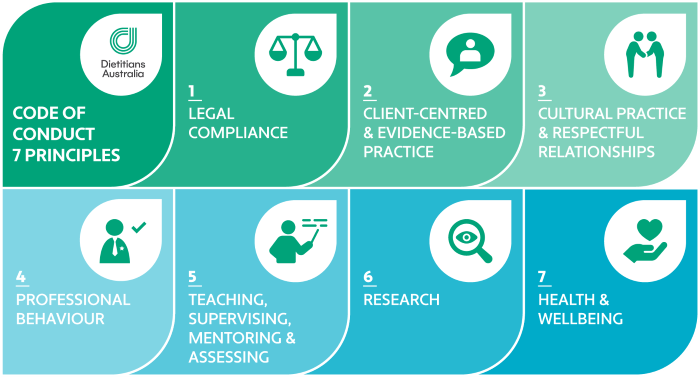
The Code includes 7 principles of conduct. The principles are described with guidance on how to apply them in practice.
The 7 principles are:
- Legal compliance
- Client-centred and evidence-based practice
- Cultural practice and respectful relationships
- Professional behaviour
- Teaching, supervising, mentoring and assessing
- Research
- Health and wellbeing
Who does this Code apply to?
The Code applies to Dietitians Australia members and dietitians who hold APD status, regardless of whether they are a Dietitians Australia member.
A breach of this Code may result in a complaint being made against an APD or Dietitians Australia member. Read our complaints process.
Download our Code of Conduct for Dietitians and Nutritionists
Updating the Code
The Code of Conduct was reviewed in 2021 and replaced the following 4 documents:
• Code of Professional Conduct – for members with Australian recognised dietetic qualifications, and non-members with APD status (March 2013)
• Code of Professional Conduct – for members without Australian recognised dietetic qualifications and non-member Accredited Nutritionists (Oct 2011)
• Statement of Ethical Practice – for members with Australian recognised dietetic qualifications and non-members with APD status (Dec 2014)
• Statement of Ethical Practice – for members without Australian recognised dietetic qualifications and non-member Accredited Nutritionists (Oct 2011)
Updated Code Due for Release November 2026
Built for the way dietitians practise today.
Following an extensive review and consultation process, Dietitians Australia is pleased to announce the completion of the updated Code of Conduct for Dietitians in Australia.
The new Code builds on the 2021 Code while reflecting how dietetics has evolved, the diverse communities we work with and the changing expectations of the profession.
So, what’s changed?
5 simple principles.
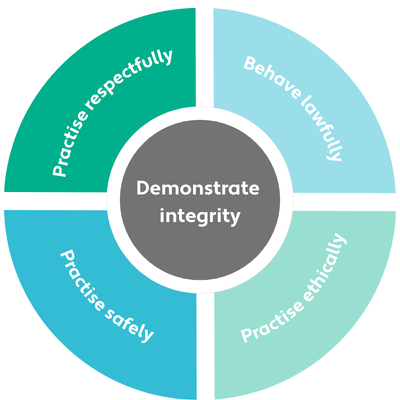
The Code has moved from four domains and seven principles to five clear, action-focused principles:
81 clearer standards.
We have streamlined the Code from 117 to 81 standards, removing duplication, overly detailed requirements and content better addressed through the National Competency Standards. Importantly, the majority of the existing standards have been retained.
A broader view of dietetic practice.
The new Code recognises that dietitians work in many different ways and settings — from individual care to communities, organisations, businesses, government and non-government agencies, as well as providing expert advice.
Greater focus on inclusion and respect.
The updated Code reflects contemporary expectations around cultural safety, diversity, inclusion, neurodiversity, stigma and discrimination, including supporting diverse eating preferences and challenging practices that may cause harm or exclusion.
More practical and easier to use.
The language and structure have been streamlined, with principles expressed as actions. A clear visual model will also show how the principles, sub-principles and standards fit together.
What does this mean for you?
The updated Code is designed to be more than a document you read once. It is a practical tool to support your everyday professional decision-making.
Whether you are navigating an ethical dilemma, working with a diverse community, providing expert advice, supervising others or practising online, the Code can help you understand your professional responsibilities and make informed decisions.
The updated code can be found here (effect 4 November 2026)
A plain text poster for consumers is now also available for clinics and consulting rooms to support the public to better understand the Code.
To learn more about the Code visit the free webinar for DA members at Introducing the new Code of Conduct for Dietitians
Mark the date
The new Code comes into effect 4 November 2026
The updated Code will officially be implemented on Day 1 of the 2026 membership renewal period
Get in touch
If you have any questions about the Code of Conduct contact credentialing@dietitiansaustralia.org.au